Skilled Trades Accelerator (STA)
Workers Ready. Systems Not.
Workforce Alignment Diagnostic | Cohort 1 | Western New York
The Challenge
What happens when individuals are willing, available, and prepared to work—but the employment system struggles to translate that readiness into actual opportunities?
The P2Solutions Skilled Trades Accelerator (STA) was developed to investigate this disconnect.
Focusing initially on entry-level concrete laborers in Western New York, STA tested recruitment, intake, candidate screening, and employer-alignment processes to better understand why workforce readiness does not always translate into viable employment.
The central question: Are we experiencing a shortage of ready workers—or a breakdown in the systems responsible for connecting workers to opportunities?
Cohort 1: Project Overview
Target Occupation: Entry-Level Concrete Laborers
Geographic Focus: Buffalo, Niagara Falls, and surrounding Western New York communities.
Primary Objective: Test workforce intake, screening, geographic feasibility, and employer-alignment processes.
Project Type: Applied workforce diagnostic and operational pilot.
Our Approach
Cohort 1 used multiple recruitment channels, including social media, community referrals, workforce-oriented outreach, and employment platforms.
Candidates were assessed for work eligibility, availability, transportation, relevant experience, physical readiness, and interest in skilled trades careers.
The objective was not simply to recruit participants. It was to examine the conditions required to move individuals from initial interest toward a viable employment opportunity.
Methodological Note
Cohort 1 represents a deliberate, directional sample designed to test intake, screening, and employer-alignment mechanics rather than to estimate regional workforce volume.
Key Findings
1. Worker Readiness Was Not the Primary Constraint
Cohort 1 identified individuals who demonstrated availability, interest in skilled trades careers, and willingness to perform physically demanding work.
Candidates brought varying levels of experience in concrete work, construction, landscaping, demolition, equipment operation, and related fields.
Nearly all passed the initial screening process and were considered ready for onboarding.
The presence of ready candidates did not guarantee access to viable employment opportunities.
2. Employer-Side Volatility Limited Placement Feasibility
Employer-side volatility—including inconsistent onboarding timelines, communication gaps, and geographically mismatched job sites—was the primary determinant of placement feasibility, not candidate readiness.
These conditions complicated the conversion of screened candidates into viable employment starts.
The finding raises questions about employer responsiveness, onboarding capacity, coordination, and accountability within workforce development systems.
3. Geography and Transportation Shape Opportunity
An employment opportunity can exist within a region while remaining functionally inaccessible to an otherwise qualified candidate.
Transportation availability, job-site location, shift schedules, commute costs, and transit infrastructure all influence whether an opportunity is realistically accessible.
A job that cannot reasonably be reached is not a viable employment opportunity for that worker.
4. Existing Skills Do Not Always Translate Into Career Pathways
Some participants possessed relevant work histories, industry exposure, or credentials.
Yet translating those experiences into defined employment entry points and advancement pathways remained a challenge.
Workforce systems must do more than prepare individuals. They must also connect existing skills to accessible opportunities, additional credentials, and career progression.
Examine the Evidence
Skilled Trades Accelerator — Cohort 1 Data Sheet
The findings presented above are supported by P2Solutions' Cohort 1 workforce diagnostic, which documents candidate readiness, recruitment and screening signals, employer coordination challenges, geographic barriers, and opportunities for system improvement.
The report includes a cohort snapshot, key diagnostic observations, recommendations for future testing, and a proposed framework for measuring workforce conversion.
Cohort 1 represents a directional operational test, not a representative assessment of the Western New York labor market.
[View the STA Cohort 1 Data Sheet (PDF)]
What These Findings Mean
Workforce Development Requires More Than Workforce Readiness
Cohort 1 points toward a broader coordination challenge.
Workers, employers, workforce programs, transportation infrastructure, and community organizations may all exist within the same regional ecosystem.
But their presence does not necessarily mean they operate as a coordinated system.
When recruitment, screening, employer demand, transportation, and onboarding are disconnected, individuals can remain ready for employment without reaching a viable start.
The challenge is not simply building a larger workforce pipeline. It is improving the system's ability to convert readiness into opportunity.
These findings are directional and should not be interpreted as representative conclusions about the entire Western New York labor market.
From Diagnosis to Improvement
The next stage of STA development should test improvements in four areas:
Employer Alignment
Establish clearer expectations for job openings, qualifications, interview timelines, onboarding procedures, communication, and feedback.
Transportation Feasibility
Assess commute conditions, job-site geography, shift compatibility, and transportation access before referring candidates to opportunities.
Skills-to-Career Pathways
Better connect existing experience and credentials to entry-level employment, additional training, apprenticeship opportunities, and career advancement.
Performance Measurement
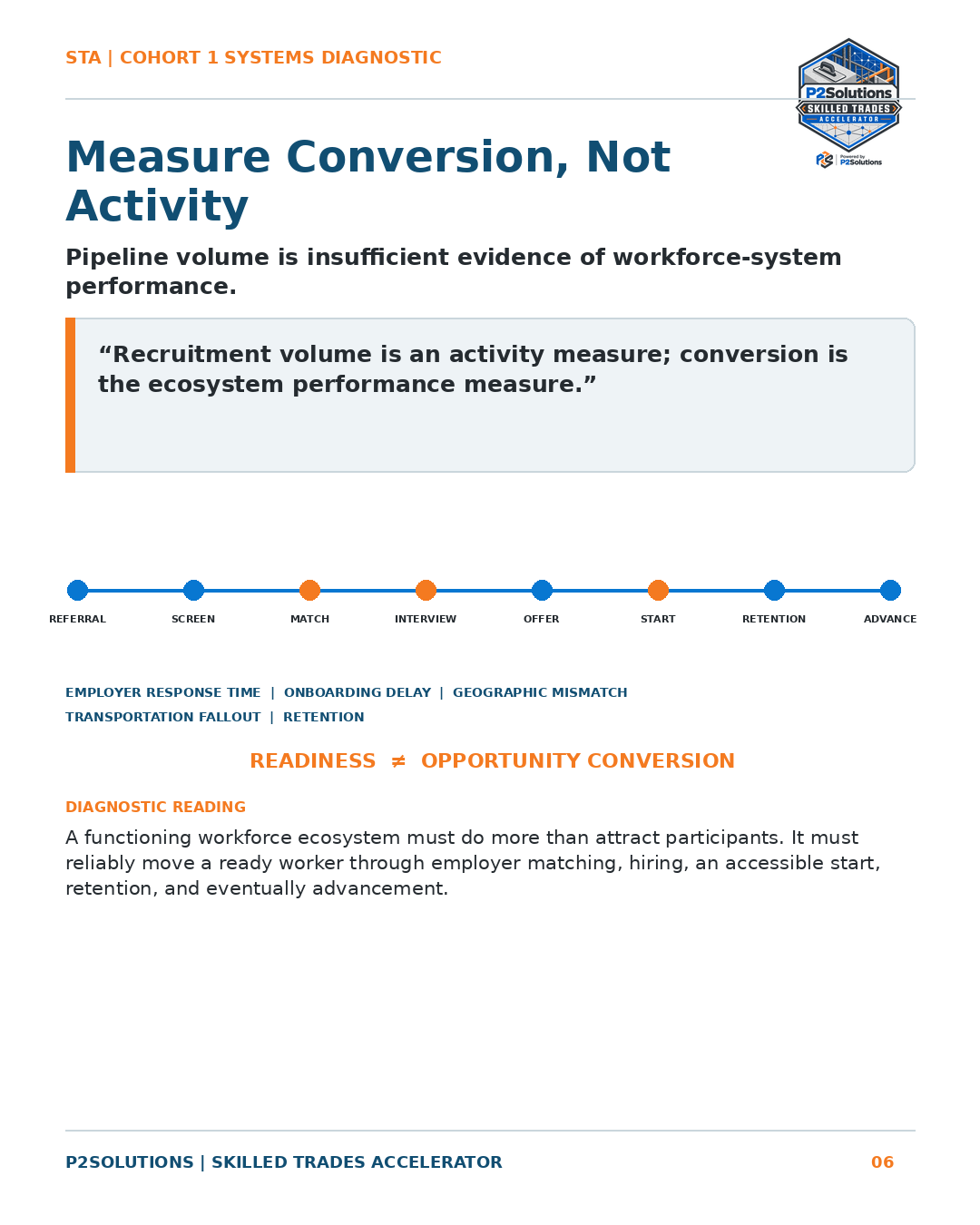
Move beyond recruitment totals to examine how effectively candidates progress through the employment process.
Measuring What Matters
The workforce conversion framework illustrates how STA proposes to evaluate performance beyond recruitment activity. By examining employer response times, onboarding delays, transportation barriers, geographic mismatches, and retention, workforce partners can identify where employment pathways break down.
This framework represents a proposed measurement approach, not completed placement or retention outcomes from Cohort 1.
The Larger Lesson
Workers Ready. Systems Not.
The Skilled Trades Accelerator demonstrates the value of examining workforce development challenges through a systems lens.
Preparing individuals for employment is important.
But preparation alone cannot overcome inconsistent employer processes, inaccessible job locations, fragmented coordination, or unclear advancement pathways.
A workforce system should be evaluated not only by how many people it prepares, but by how effectively it connects that preparation to viable employment and long-term opportunity.
Explore Opportunities for Collaboration
P2Solutions is interested in engaging employers, workforce development organizations, educational institutions, public agencies, and community partners seeking to improve workforce alignment and employment pathways.
Are ready candidates struggling to connect with viable opportunities in your organization or community?
Let's examine the barriers, identify underlying constraints, and explore practical alternatives.
[Contact P2Solutions to Discuss Workforce Alignment]
P2Solutions | People • Systems • Possibilities